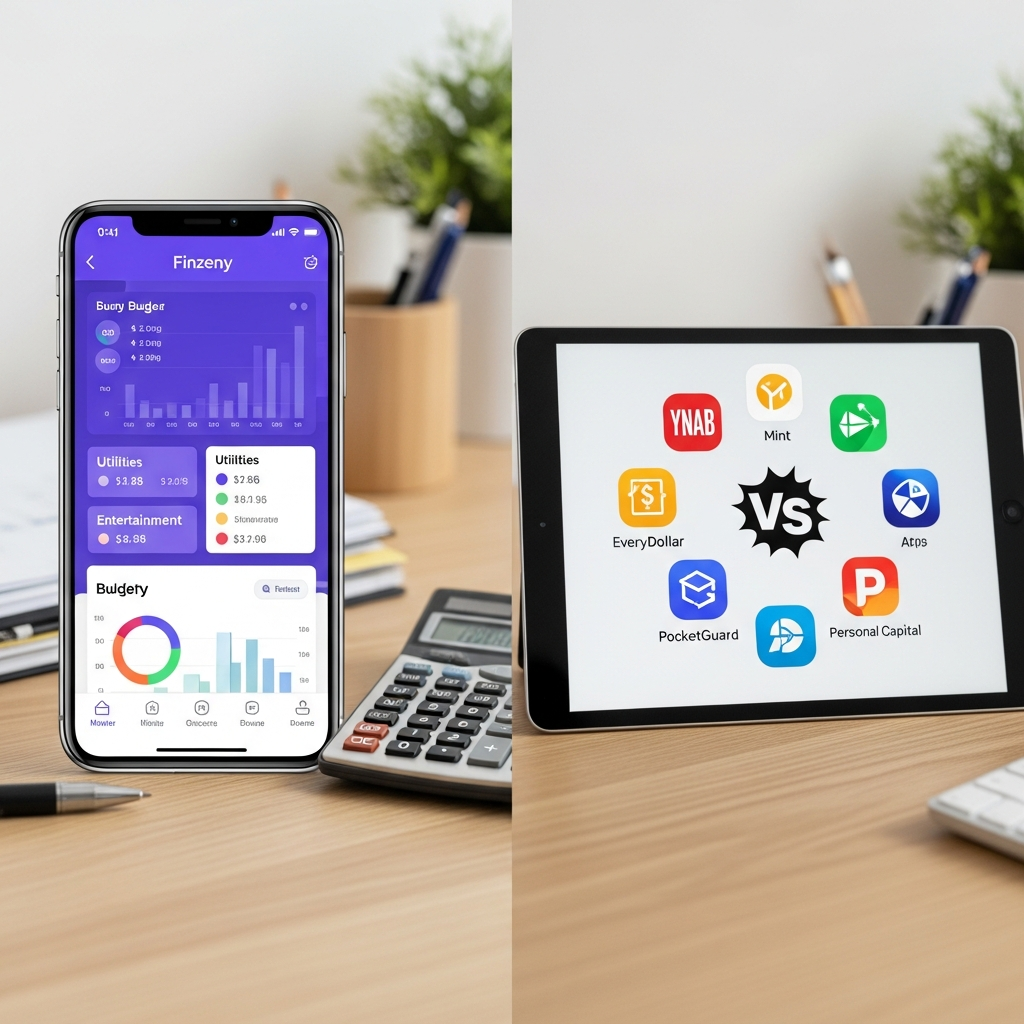
Navigating the world of personal finance apps can be daunting, with numerous options vying for your attention. This article dives deep into a head-to-head comparison between Finzeny and its leading competitors. We’ll explore their unique features, usability, and overall value to help you determine which tool will best support your financial goals in the coming years and beyond.
Understanding the Modern Personal Finance Landscape
The landscape of personal finance applications has undergone a radical transformation, moving far beyond the rudimentary spreadsheet budgeting of yesteryear. Today’s users demand comprehensive digital platforms that offer an integrated approach to financial management. The core expectation now includes
- intuitive budgeting tools that simplify expense tracking and categorization,
- robust investment tracking for diverse portfolios,
- automated savings features designed to achieve specific financial milestones effortlessly.
and
This evolution is driven by sophisticated AI and machine learning algorithms, which elevate mere data aggregation to personalized financial advice, predicting future trends and suggesting optimized strategies. User experience and robust security measures have emerged as paramount consumer priorities, alongside the critical ability to integrate seamlessly with various financial institutions and ensure real-time data synchronization, providing an accurate, up-to-the-minute financial panorama. This advanced foundation sets the stage for tools like Finzeny.
Introducing Finzeny Key Features and Philosophy
Finzeny distinguishes itself by seamlessly integrating advanced features with a user-centric philosophy. Its Intuitive Budgeting transcends basic tracking, employing smart algorithms that learn spending patterns for effortless categorization and predictive insights, allowing users to anticipate and manage future expenses with unprecedented ease. For Investment Monitoring, Finzeny offers a comprehensive hub, unifying diverse portfolios—from traditional equities to digital assets—with real-time performance analytics and risk diversification tools, providing a holistic view of wealth growth. Setting Savings Goals becomes an engaging journey through visual progress trackers and intelligent recommendations that optimize contributions, accelerating users towards their financial milestones. Moreover, its robust Financial Reporting delivers not just data, but deeply insightful, customizable visualizations that transform complex information into clear, actionable intelligence. The underlying philosophy centers on empowering users through proactive money management, moving beyond mere data aggregation to foster confident financial decision-making and genuine financial empowerment.
Competitor Analysis The Leading Budget Apps
The personal finance landscape is diverse, with several established players competing for user attention. Mint, long a dominant free option, caters to users seeking basic expense tracking and bill reminders, offering extensive bank integrations. Its interface, while functional, can feel dated and ad-heavy, impacting the overall user experience. Security is standard, but its ad-supported model raises privacy questions. Conversely, You Need A Budget (YNAB) targets disciplined individuals with its strict zero-based budgeting methodology. While transformative for many, its learning curve and premium subscription cost ($99/year) can be barriers. YNAB’s UI is clean but less focused on diverse investment monitoring or advanced reporting. For investors, Personal Capital offers robust net worth and investment tracking, with excellent bank connectivity and strong security. However, its budgeting features are rudimentary, and the platform primarily serves as a gateway to paid advisory services, lacking the integrated, proactive daily money management Finzeny champions.
Feature-by-Feature Comparison Finzeny’s Edge
Beyond the general competitive overview, a direct feature comparison illuminates Finzeny’s significant edge. For expense categorization, Finzeny deploys advanced AI for hyper-accurate, automated tagging, surpassing rivals’ rule-based systems. Bill management stands out with proactive, personalized reminders and predictive insights, outperforming basic notifications. Its net worth calculation offers a truly holistic, real-time aggregation of diverse assets, surpassing many competitors. Debt management tools excel with tailored payoff strategies and projections, actively accelerating financial freedom. Goal-based savings benefit from smart automation and predictive analytics, outperforming manual competitor approaches. Lastly, Finzeny’s customer support frequently includes 24/7 in-app assistance and dedicated guidance, offering superior responsiveness and trust where many competitors provide limited channels. These distinctions offer the average user unparalleled financial control and efficiency, solidifying Finzeny’s claim, though some competitors may present specialized features for niche requirements.
User Experience and Accessibility A Deciding Factor
Beyond raw features, the daily interaction defines an app’s longevity. Finzeny excels in ease of setup, often integrating bank accounts with a few clicks, unlike competitors requiring convoluted multi-step authentication processes. Its navigation is commendably intuitive; key financial data and tools are logically grouped, reducing clicks and user frustration significantly. The experience remains fluid across devices, with its mobile app mirroring desktop functionality and responsiveness – a critical point where some top budget apps struggle with inconsistent interfaces. Finzeny’s learning curve is surprisingly gentle, even for advanced features like custom report generation, thanks to contextual help. Crucially, its commitment to accessibility is evident, offering robust screen reader compatibility and customizable display options, empowering a broader user base. This superior UX directly translates to higher user satisfaction and retention, making it a powerful differentiator in the 2026 landscape.
Making Your Choice The Best Fit for Your Finances
Choosing your ultimate personal finance tool in 2026 demands self-reflection beyond just features. Start by clarifying your primary financial goals: Are you aggressively tackling debt, building a substantial emergency fund, or optimizing investment portfolios? Apps vary wildly in their specialized support for these objectives. Next, consider your preferred level of automation; do you seek hands-off categorization and automatic insights, or prefer granular manual control over every transaction? This dictates whether an AI-driven solution or a manual input system suits you best. Evaluate your budget for a finance app, distinguishing between robust subscription services and viable free options. The importance of comprehensive reporting also varies; some require detailed customizable insights for strategic planning, while others need only basic overviews. Finally, assess if specific integrations, like those with particular investment brokers or lesser-known banking services, are crucial for a unified financial picture. Remember, the best app is inherently subjective. Leverage trial periods to directly experience how Finzeny or any competitor aligns with your unique financial DNA and personal workflow.
Conclusions
In conclusion, selecting the ideal budgeting app hinges on your individual financial habits and preferences. While Finzeny offers a robust set of features, competitors also present compelling advantages. The best personal finance tool in 2026 will ultimately be the one that aligns most closely with your specific needs, helping you achieve greater financial clarity and control.